

Why We Don’t Reset Dogs (or Humans) in January

January arrives quietly up north.
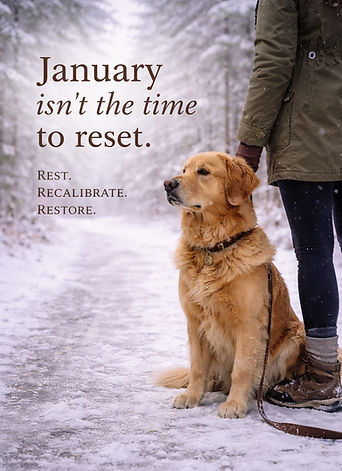
The roads are slower. The trails are quieter. The lake looks like it’s holding its breath. After the noise and momentum of December, January doesn’t rush to replace it with anything new. It simply asks us to pause.
And yet, culturally, January is obsessed with resets.
New year. New habits. New rules. New expectations — for ourselves, and often, for our dogs. Training plans restart. Routines tighten. Behavior gets scrutinized. The assumption is that this is the moment to fix what wasn’t perfect before.
But winter tells a different story.
Up north, January isn’t a clean slate. It’s a recovery phase.
January Is Not a Time for Resetting — It’s an Integration
In nature, nothing resets in January.
Animals conserve energy. Systems slow. Growth pauses so repair can occur beneath the surface. This isn’t stagnation — it’s regulation.
Humans feel this too, whether we name it or not. Shorter days affect circadian rhythms. Reduced sunlight impacts mood, energy, and stress regulation. The body naturally leans toward rest, reflection, and lower stimulation during the winter months.
Dogs are no exception.
After the disruptions of the holidays — visitors, travel, altered schedules, heightened noise — many dogs enter January already neurologically taxed. What they need most isn’t correction or pressure. It’s predictability and relief.
Resetting assumes something is broken.
January care assumes something is recovering.
Why “Reset Culture” Can Backfire for Dogs
From a behavioral science perspective, sudden changes in expectations can increase stress — especially in animals who rely on consistency to feel safe.
When we reset too aggressively in January, we often see:
increased anxiety or clinginess
regression in training behaviors
heightened reactivity
shutdown or withdrawal
These aren’t signs of failure. They’re signs of overload.
Stress physiology doesn’t respond well to abrupt demand. Research shows that learning, emotional flexibility, and behavioral stability improve when animals experience predictable environments, adequate rest, and supportive pacing—not constant correction or novelty.
In other words, nervous systems don’t reset. They recalibrate.
And recalibration takes time.
Winter Is a Season for Regulation, Not Reinvention
Up north, winter teaches restraint by necessity.
You don’t push harder on icy ground. You don’t ignore shorter daylight. You adjust your footing. You plan differently. You move with intention instead of force.
That same logic applies to care.
January is when routines matter most — not new ones, but familiar ones. Walks may be shorter, but steadier. Expectations soften. Stimulation lowers. The goal shifts from improvement to stability.
This isn’t lowering standards. It’s respecting biology.
Dogs Aren’t Behind — They’re Processing
Behavior doesn’t exist in isolation. It reflects the environment, stress load, and nervous system state.
What looks like a “setback” in January is often a dog processing:
the absence of holiday stimulation
the return to quieter days
colder weather and sensory changes
shifts in human energy
When we allow space for that processing — without rushing to label or fix — regulation returns more naturally.
Humans benefit from the same grace.
January is not a test of discipline. It’s an invitation to notice what still feels tender.
Why We Choose Continuity Over Correction
At Northern Paws, we don’t believe January needs a reset.
We believe it needs continuity.
Care that stays steady. Routines that remain familiar. Expectatio
ns that adapt to the season rather than fight it. This is how trust deepens — quietly, without performance.
Winter doesn’t ask for reinvention. It asks for patience.
And patience, up north, is a skill you learn by living here.
📚 References & Further Reading
Porges, S. W. (2011). The Polyvagal Theory: Neurophysiological Foundations of Emotions, Attachment, Communication, and Self-Regulation.
Overall, K. L. (2013). Manual of Clinical Behavioral Medicine for Dogs and Cats.
Beerda, B., et al. (1998). Behavioral, saliva cortisol, and heart rate responses to different stimuli in dogs. Applied Animal Behaviour Science.
Walker, W. H., et al. (2020). Circadian rhythm disruption and mental health. Translational Psychiatry.
Landsberg, G., Hunthausen, W., & Ackerman, L. (2013). Behavior Problems of the Dog and Cat.

Comments